
Every house has one. The room that is ten degrees off from the rest of the place, the one where guests quietly put their jacket back on, the one you show people last. In my house it is the back room at the end of the hall, and for three winters it was also my office. I spent those winters convinced the problem was my furnace. The problem was that I kept asking one machine in the basement to solve a problem that lived sixty feet away.
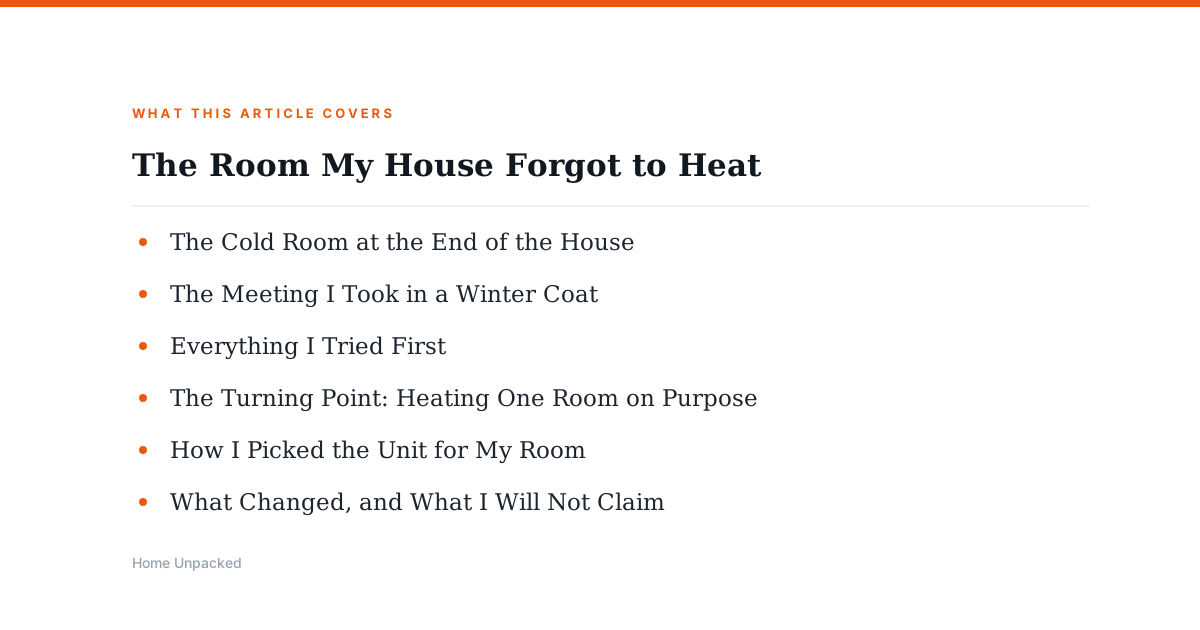
The Cold Room at the End of the House
I am Dana. I keep the books for about a dozen small businesses, which means tax season owns my January and my February, and it means I work from home in the coldest months of the year. My office is a back room that a previous owner added on. It has good light, a door that closes, and one heating vent that I am fairly sure is decorative.
The rest of the house is fine. That is the maddening part. The living room is comfortable. The kitchen is comfortable. Then you walk down the hall, open my office door, and step into a different season. In February that room ran cold enough that I typed in fingerless gloves like a Victorian clerk. In August it ran hot enough that I moved my afternoon calls to the kitchen table because I did not want clients to watch me sweat on video.
I did what everybody does. I turned up the thermostat. Which is to say I heated four rooms I was not sitting in so that a little more warmth might trickle into the one I was. My furnace worked harder, the rest of the house got stuffy, my partner opened a window in the living room out of self defense, and my office stayed cold. If you have ever done this, you know the feeling of a fix that is somehow making everything worse in every direction at once.
The Meeting I Took in a Winter Coat
The moment I stopped tolerating it was a Tuesday morning in late January. A new client, first real call, the kind where you want to look like somebody who has their act together. I set up early, made coffee, opened the laptop. Twelve minutes in, my hands were cold enough that I was mistyping numbers, which in my line of work is not a charming quirk.
So I put my coat on. On camera. Mid call. And the client, who was lovely about it, laughed and said something like, oh, is your heat out? And I said no. My heat is fine. My heat is just somewhere else.
I was not heating a room. I was heating a hallway and hoping some of it turned left.
That sentence rattled around my head for a week. I had been treating a cold office as a personality trait of the house, something to endure, like a squeaky stair. It had not occurred to me that a room could simply have its own climate, and that this was a thing normal people bought.
Everything I Tried First
In fairness to my own stubbornness, I did not go straight to a big purchase. I went through the entire catalog of cheap fixes first, and I want to be honest about how each one actually went:
- A space heater. It warmed the three feet directly in front of it and nothing else, so I sat in a small bubble of heat with a cold back. It also shared a circuit with my desk, which I learned the hard way when the breaker cut out and took my monitors with it in the middle of a reconciliation.
- A second space heater, because obviously the answer was more space heater. Two of them tripped the breaker faster. I also started having the thought every single night about whether I had definitely turned them both off, which is not a thought you want to be having at 2 a.m.
- A window air conditioner for the summer half of the problem. It did cool the room, and it also blocked the good light, buzzed through every phone call, and had to be wrestled in and out twice a year and stored somewhere. It solved four months and made the other eight slightly worse.
- A door draft stopper and a heavy curtain. These actually helped a little, and I still use them, and they are not a heating system. Sealing a room does not add heat to it.
The pattern only became obvious after I had spent the money. Every fix was portable, temporary and pointed at a symptom. What I needed was for that room to have its own heating and cooling, permanently, the way the rest of the house has a furnace, and to stop negotiating with a vent that was never going to deliver.
The Turning Point: Heating One Room on Purpose
The phrase that finally unlocked it for me was ductless mini split. One outdoor unit, one indoor unit, a small line between them, and the room gets its own heating and its own cooling without touching my ductwork or my furnace. Once I understood that existed, my problem stopped being a mystery and became a shopping question.
That is when I found Della. The homepage leads with two lines that are almost annoying in how precisely they describe what I wanted: Comfort, handled. Designed to fit right where you need it. Right where I need it. Not four rooms away, downstairs, behind a wall.
I want to be straight about what follows. Everything I say about Della products below is what the company states on its own site. I am not a testing lab, I did not put competing units on a bench, and I am telling you how their catalog lined up with a very specific problem in one very specific room at the end of my hallway.
How I Picked the Unit for My Room
One room, or the whole house later
- Della sorts systems into single zone and multi zone, with multi zone options running from 2 zones up to 6.
- For me: I only had one problem room, so single zone was the whole conversation. But I liked seeing the multi zone options sitting right there, because my partner has already pointed at the garage. If that ever becomes a project, I know the same brand covers it.
Sizing, which is the part people get wrong
- Their mini splits come in 9,000, 12,000, 18,000, 24,000 and 36,000 BTU options.
- For me: this was the number I spent the most time on, and the one I would tell you not to guess at. A back room addition is not the same as an open plan living area, and BTU sizing depends on square footage, insulation, ceiling height and climate. Use their sizing information and talk to a licensed installer rather than picking a size because it sounds generous.
Cold weather is its own category
- Within single zone, Della splits the lineup into tiers with names that tell you what they are for: Base Model, Efficiency, High Efficiency, Ultra Heat and Ultra Hyper Heat.
- For me: my whole reason for doing this was winter, so the heat focused tiers were where I read most carefully. If your problem room is a summer problem, that changes which tier you are even looking at. Check the specifics for the model and the climate you actually live in, because this is exactly the kind of detail where a blog post is no substitute for the product page.
Where the indoor unit goes
- The catalog is organized by type as well: wall mount, cassette, ducted and floor ceiling.
- For me: wall mount was the obvious pick, because the one thing my office has going for it is the window and I was not about to block it again. But the reason I mention the other types is that this is where a mini split gets genuinely flexible. A finished attic, a room with a low sloped ceiling, a space where you do not want a visible box on the wall, those are different answers, and they exist.
Efficiency and the app
- Della offers Energy Star labeled products, and the site calls out smart app control.
- For me: the Energy Star label mattered because the entire point was to stop overheating the whole house to warm one room, and I wanted something that carried a recognized efficiency label rather than a vague promise. The app control turned out to be the small daily thing I appreciate most. I warm the office from the kitchen while the coffee brews, and I walk down the hall into a room that is already comfortable.
The buying and owning part
- The site states free shipping, ships in 24 hours, 0% APR financing available, and 24/7 live chat with real support. There is an HVAC Help Center with manuals, troubleshooting guides and installation videos, plus warranty registration, and a return and refund policy in the footer.
- For me: the help center is the part I would point at if you are nervous. Manuals and installation videos being a findable, public thing before you buy tells you something about what ownership looks like after you buy. I still had a professional handle the install and the electrical, and I would tell you to price that in from the start. Read the current shipping, warranty and return terms on their site yourself, because terms change and mine are not necessarily yours.
What Changed, and What I Will Not Claim
I am not going to give you a percentage off my energy bill. I did not run a controlled experiment, my winter was not identical to last winter, and anybody who hands you a precise number out of a personal story is inventing it. If you want numbers, get a quote and look at the efficiency ratings on the actual model you are considering.
Here is what I can tell you honestly, as the person who lives here. I do not wear a coat indoors anymore. I stopped fighting my thermostat, and the living room stopped being a sauna, and nobody opens a window in January out of protest. I do not have the 2 a.m. thought about whether the space heaters are off, because there are no space heaters. And my window is a window again, all twelve months, which I did not realize I resented until I got it back.
The bigger change is one I did not predict. That room stopped being a place I fled from. I used to move to the kitchen table at 2 p.m. every summer afternoon and at 8 a.m. every winter morning, dragging my laptop and my notes around my own house on a schedule set by the weather. Now I go to my office and I stay in it. The room became part of the house instead of a room the house had given up on.
Is a Mini Split Overkill for One Room?
This was my hesitation, and I am not going to pretend it away. A mini split is a real purchase and a real install. A space heater is thirty seconds and a plug. If your cold room is the guest bedroom your sister uses twice a year, buy the space heater, be happy, and close this tab with my blessing.
But run the honest version of the math on how much of your life the room actually holds. Mine held my job, five days a week, for the coldest and hottest months of the year, and I had been paying for that room three separate ways: in heaters that did not work, in a whole house running hotter than it needed to, and in hours of my workday relocated to a kitchen table. Framed that way, doing it properly once was not the extravagant option. It was the one that stopped the bleeding.
What I would not do is buy on vibes. Confirm the sizing for your actual room, confirm what the install needs in terms of electrical and mounting, get a licensed installer involved, and read the current specs, warranty and return terms on the product page. A mini split is the kind of purchase that goes well when you are boring and careful about it.
The New February
There used to be a version of me who apologized for her own office. Who kept a blanket over the back of the chair in a room she was paying to heat. Who told clients the house was old, as if that explained anything, and who treated one cold room as weather rather than as a problem with a solution.
This February I took a first call with a new client at 8 in the morning with the door closed and my sleeves pushed up. No coat. No buzzing box in the window. No small talk about my heating. It is such a small thing to write this many words about, and it quietly gave me back four months of the year.
Should You Take a Look?
If there is a room in your house that the ductwork forgot, a converted garage, a finished attic, an addition, a sunroom, a back office, and you have been solving it every year with a heater in winter and a window unit in summer, a ductless mini split is the category you have been circling without naming. Della is worth a browse for it: single and multi zone, 9,000 through 36,000 BTU, wall mount, cassette, ducted and floor ceiling, Energy Star labeled options, smart app control, and a help center with the manuals and installation videos sitting out in the open. Check the current models, specs, financing and shipping terms on their site, since those change.
An honest note before you go: this is my own story, and every product detail above comes from what Della states on its own site, not from testing we ran here. Sizing, installation and electrical work are things to confirm with a licensed professional for your specific room. If you buy through my link, Home Unpacked may earn a small commission at no extra cost to you. That never changes what I write, and it never will.
Go stand in your cold room for a minute. You know the one. - Dana
Community discussion
Enjoyed this story? Share your thoughts below.