
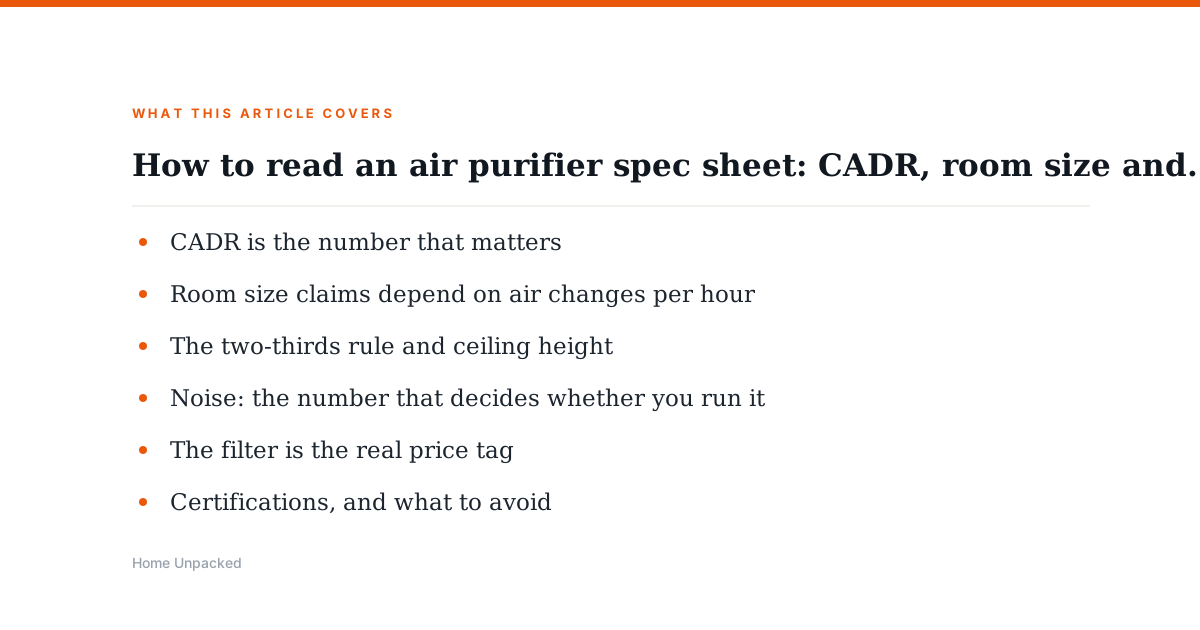
An air purifier page will tell you it covers a room of a certain size, and that figure is true only under a condition that is usually printed in smaller type next to it. The condition is how many times per hour the unit can push the room's volume through its filter, and changing it can move the stated coverage by a factor of four or five on the same machine. Learning to read that line, along with the clean air delivery rate behind it, the noise range and the recurring filter cost, is what separates a purifier that works in your bedroom from one that only works on the box. This note uses Levoit's published specifications for the Core 300-P and the U.S. Environmental Protection Agency's air cleaner guidance, both as of October 2026, to show how.
CADR is the number that matters
Clean Air Delivery Rate, or CADR, is the industry's standard measure of how much filtered air a portable purifier produces. The Association of Home Appliance Manufacturers, whose AHAM Verifide programme certifies the figure, describes CADR as the volume of filtered air an air cleaner delivers, with separate scores for tobacco smoke, pollen and dust. The EPA's guide to air cleaners in the home states that the higher the CADR, the more particles the air cleaner will remove and the larger the area it can serve. In the United States CADR is expressed in cubic feet per minute. Levoit's product page for the Core 300-P lists a CADR of 143 CFM, as of October 2026.
When a listing quotes CADR, check whether it shows one figure or three. A single figure may be the smoke rating, the lowest of the three, or an average; the page does not always say. Where a product shows no CADR at all and relies on a room-size claim alone, there is no way to compare it with one that does, and the omission is itself useful information. AHAM's own guidance for wildfire smoke is to choose a unit whose smoke CADR equals the room's area in square feet, which is a stricter standard than the general rule below.
Room size claims depend on air changes per hour
The same purifier can be advertised for very different room sizes depending on how many air changes per hour, or ACH, the maker assumes. Levoit's Core 300-P page makes this unusually explicit: it lists an ideal room size of 1066 square feet at 1 ACH and 222 square feet at 4.8 ACH, as of October 2026. Both numbers describe the same 143 CFM machine. At one air change per hour, the unit filters the room's volume once every sixty minutes, which is a slow rate for anyone with allergies or smoke concerns. At 4.8 changes per hour it filters the room roughly every twelve and a half minutes, which is the figure most relevant to a bedroom or office.
The practical reading is to ignore the larger number unless the page states the ACH behind it and you are satisfied with that rate. If a listing shows a single coverage figure with no ACH, assume it is the generous low-ACH number. When comparing two purifiers, compare them at the same ACH, or better, compare CADR directly and do the sizing yourself using the rule in the next section. Our Levoit Core 300 review uses the 4.8 ACH figure for its room recommendations for exactly this reason.
The two-thirds rule and ceiling height
AHAM's published rule of thumb is that the CADR of your air cleaner should be equal to at least two-thirds of the room's area in square feet. The EPA's sizing chart expresses the same idea in a table: a 200-square-foot room requires a minimum CADR of 130 CFM, and a 400-square-foot room needs 260 CFM, per its guide as of October 2026. Applied to the Core 300-P's 143 CFM, the two-thirds rule gives a room of about 215 square feet, which lines up closely with Levoit's own 222-square-foot figure at 4.8 ACH. That agreement is a sign the manufacturer's high-ACH number is honest; a wide gap between the two would be a reason to look harder.
The EPA adds a condition that most product pages omit: the CADRs are calculated based on an 8-foot ceiling, and if you have higher ceilings, you may want to select a portable air cleaner with a higher CADR. A room with 10-foot ceilings holds a quarter more air than the same floor plan with 8-foot ceilings, so the two-thirds rule under-sizes it by roughly that amount. Measure length, width and height, and if the ceiling is tall, scale the required CADR up before shopping.
Noise: the number that decides whether you run it
A purifier only cleans air while it is switched on, and the speed people leave it on overnight is usually the quietest one, not the one the CADR was measured at. Levoit lists the Core 300-P noise range as 24 to 54.5 dB as of October 2026. The EPA offers a reference point: a noise rating around 50 decibels is roughly the operating noise of a modern refrigerator. So the top of this unit's range is slightly louder than a fridge, and the bottom is well below one. The CADR figure applies at the high setting; at the quiet setting, airflow and therefore cleaning rate are lower, and the maker does not publish a CADR for each speed.
When a page gives only one noise figure, check whether it is the minimum or the maximum. A single low number is likely the sleep mode. A single high number is rarer and more honest. Where two numbers are given, the gap between them tells you how much the unit slows down to get quiet. For a bedroom, size the purifier so that the speed you can sleep next to still meets the two-thirds rule for the room, which in practice means buying a unit rated for a larger space than the bedroom itself.
The filter is the real price tag
The purchase price is the smaller part of what a purifier costs over its life. Levoit lists the Core 300-P at a regular price of $99.99, shown on sale at $84.97, and lists replacement filters at $29.99 for the original filter, $35.99 for the pet allergy variant and $39.99 for the smoke remover variant, as of October 2026. The page as read does not state a replacement interval, so the honest statement is that Levoit's product page does not publish it there; the manual or the filter page may. Whatever the interval, multiply the filter price by the number of changes per year and add it to the purchase price to get a first-year cost, then use the filter figure alone for every year after.
Two more running costs are on the sheet. Levoit lists the Core 300-P's rated power at 56 W on 120 V, 60 Hz. At the high setting for several hours a day that is a modest but non-zero electricity cost, and the page does not state the draw at lower speeds. Dimensions and weight, listed at 8.7 by 8.7 by 14.2 inches and 7.9 lb, matter for where it can go; a purifier needs clearance around its intake, and one that ends up behind a sofa is not delivering its rated CADR. The guide to the best home upgrades under $100 treats the filter cost as part of the price for this reason.
Certifications, and what to avoid
Levoit's page states the Core 300-P is CARB compliant, FCC certified and ETL listed, as of October 2026; it does not mention Energy Star or an AHAM Verifide mark on the page as read. CARB compliance is the California Air Resources Board's certification that the unit meets its ozone emission limit, and it is the certification to look for on any purifier sold in the United States. The EPA is direct about the alternative: avoid portable air cleaners and furnace or HVAC filters that intentionally produce ozone, and no federal government agency has approved these devices for use in occupied spaces. A listing that advertises ozone or 'activated oxygen' as a feature is advertising something the EPA tells you to avoid.
Bottom line
Read the CADR, not the room-size headline. Size the room with the two-thirds rule, scale up for tall ceilings, and check the ACH behind any coverage claim. Read the noise range and plan for the quiet speed, because that is the one that will be running at night. Add the filter cost to the purchase price before comparing. And look for CARB compliance while steering clear of anything that generates ozone. Levoit and the EPA both publish the figures needed to do this as of October 2026; most reputable makers do, and a page that does not is telling you something too.
Community discussion
Enjoyed this story? Share your thoughts below.